

SKF and NTN Cross-Reference Wholesale Supplier 2026
Model numbers alone never guarantee interchangeability—material grade, cage design, and clearance class can silently kill your machine.
In 2026, SKF and NTN remain the two dominant forces in the global premium bearing market, yet their regional strengths and application-specific advantages diverge sharply. Buyers sourcing through a reliable SKF and NTN cross-reference wholesale supplier must combine cross-reference verification, application-based selection, and multi-layer authenticity checks to avoid counterfeits and secure equipment uptime.
I still think about that crusher line in Riyadh. The client had sourced a batch of bearings stamped SKF 22320 from a trader who promised "genuine, ready stock." Within days of installation, the main shaft seized. When I pulled the bearing apart on the shop floor, the outer ring engraving looked blurred under a loupe, the cage rivet spacing was uneven, and the origin marking didn’t match any authorized production facility. The failure wasn’t a design flaw—it was a counterfeit. That single incident cost the client a mid-six-figure sum in downtime, far beyond the price difference they thought they were saving. Since then, whether I’m sourcing deep groove ball bearings like 6205 and 6305 or spherical roller bearings like 22320, I treat every shipment as a verification exercise first and a transaction second. [NEED_CITE: global counterfeit bearing market scale and failure cost distribution]

For industrial buyers, MRO teams, and regional distributors, the lesson is simple: market position tells you which brand to consider, but cross-reference accuracy and authenticity verification tell you whether the bearing will actually survive your application.
How Has the Global Market Position of SKF and NTN Evolved in 2026?
Both SKF and NTN continue to lead the premium bearing segment, but their dominance is uneven across regions, product categories, and end-use industries.
SKF maintains its stronghold in heavy industry, mining, and wind energy applications, particularly in Europe, the Middle East, and parts of Africa. Its spherical roller bearings and tapered roller bearings are frequently specified in crushers, conveyors, and gearboxes where extended fatigue life and contamination resistance are critical. NTN, by contrast, has deep penetration in automotive, industrial motors, and precision machinery, with particularly strong distribution networks across Asia-Pacific and growing presence in Latin America. Its deep groove ball bearings and angular contact bearings are widely used in electric motors, machine tool spindles, and automotive transmissions. [NEED_CITE: SKF and NTN regional market share trends by product category in 2026]
From what I’ve observed working with distributors across the Middle East and Africa, the pattern is consistent: SKF tends to be the first choice for heavy-duty, high-load, low-speed applications, while NTN is often preferred for high-speed, precision-oriented, or space-constrained designs. However, this is a generalization—real selection depends on cross-referencing OEM specifications, verifying clearance and cage material, and confirming origin.
A distributor in West Africa once told me he kept both SKF and NTN 6205 in stock because his customers asked for them interchangeably. But when I checked the actual application—a conveyor drive running in a dusty, high-temperature environment—the NTN variant with a steel cage and C3 clearance was a better fit than the SKF variant with a polyamide cage and CN clearance. The cross-reference matched on the outside diameter and bore, but the internal specifications told a different story. [NEED_CITE: bearing selection criteria by application environment and load condition]

The takeaway for buyers is that market leadership doesn’t eliminate the need for technical due diligence. A SKF and NTN cross-reference wholesale supplier who can navigate these nuances—rather than just matching model numbers—is worth more than the lowest unit price.
How Do You Safely Cross-Reference SKF and NTN Bearing Models?
Cross-referencing is not about finding the same model number—it’s about matching bore, outside diameter, width, dynamic load rating, static load rating, clearance class, cage material, and sealing type simultaneously.
The fundamental principle behind cross-referencing is that different manufacturers may use different internal designations, suffixes, or even slightly different geometry for what appears to be the same bearing. For example, SKF’s 22320 E bearing and NTN’s 22320 BD1 bearing are both spherical roller bearings with the same basic dimensions, but the cage design, internal clearance, and lubrication groove specifications may differ. Substituting one for the other without checking these parameters can lead to premature fatigue, cage failure, or lubrication breakdown. [NEED_CITE: cross-reference methodology for spherical roller bearings across major brands]
Here is the verification sequence I follow for every cross-reference request:
- Confirm the basic dimensions: bore diameter, outside diameter, and width must match exactly. Any deviation, even within tolerance, is a red flag.
- Match the dynamic and static load ratings. These values determine whether the bearing can handle the application’s radial and axial loads over its expected service life.
- Verify the clearance class. Standard clearance (CN), C3, C4—these are not interchangeable. A bearing with C3 clearance in a high-temperature application may perform well, but the same clearance in a precision spindle application will cause vibration and noise.
- Check the cage material and design. Steel cage, brass cage, polyamide cage—each has different speed limits, temperature resistance, and lubrication requirements.
- Confirm the sealing or shielding type. Open, ZZ (shielded), 2RS (contact seal)—the wrong choice can lead to contamination ingress or excessive friction.
- Cross-check the origin marking and manufacturer’s production facility codes. This is where counterfeits most often fail.
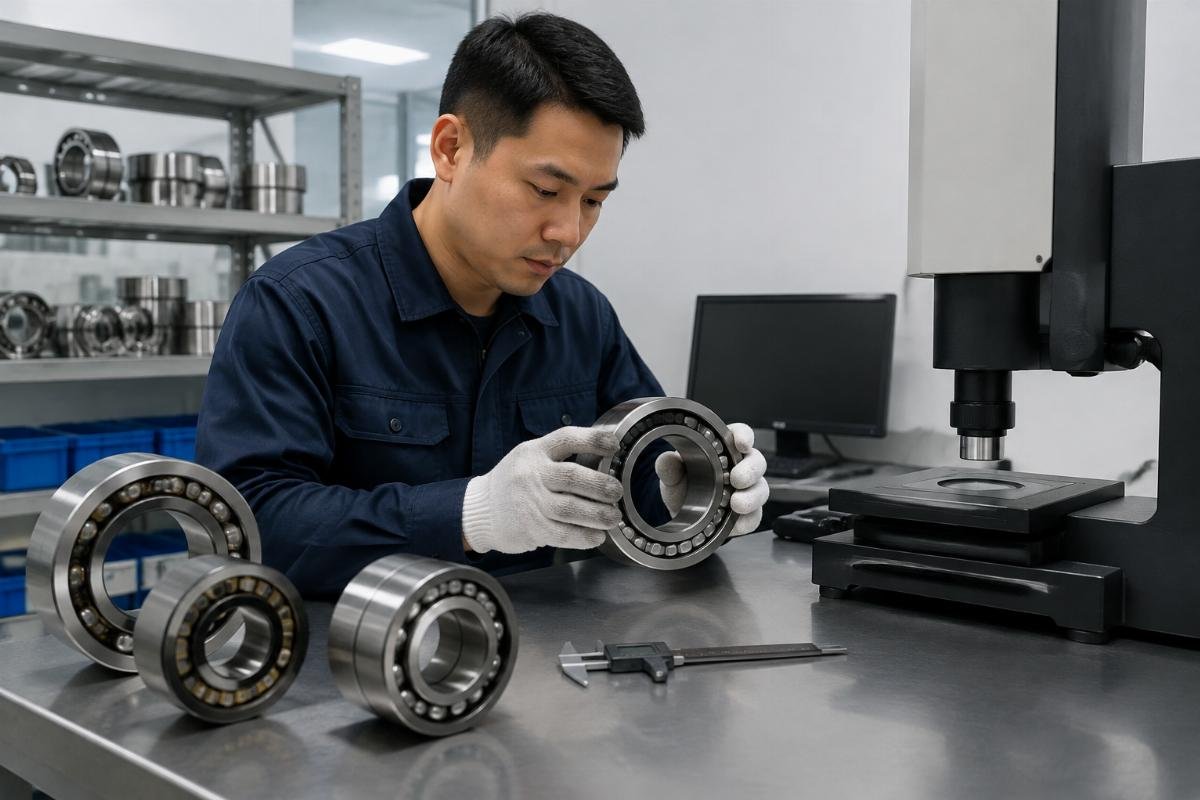
A maintenance team at a cement plant in Southeast Asia needed to replace a set of tapered roller bearings in a kiln drive. The OEM specification called for a SKF 32218, but local availability was limited. They contacted us for a cross-reference to NTN. We matched the NTN 4T-32218, but during verification, we found that the OEM unit had a specific cage material and a modified internal geometry for high-temperature operation. The standard NTN variant wouldn’t have survived. We sourced a special-order NTN variant with the matching specifications, and the replacement ran for an extended period without issue. [NEED_CITE: tapered roller bearing cross-reference challenges in high-temperature applications]
The lesson: a SKF and NTN cross-reference wholesale supplier must treat every cross-reference as a technical project, not a catalog lookup.
How Can Buyers Verify the Authenticity of SKF and NTN Bearings?
Authenticity verification is a multi-layer process: check the authorization chain, inspect the origin marking, and validate the QR code or digital traceability feature.
Counterfeit bearings are not a niche problem—they are a systemic risk in the global supply chain. Fake bearings may look identical to genuine products on the outside, but their internal material quality, heat treatment, and dimensional accuracy are often far below standard. The consequences range from premature failure to catastrophic equipment damage. [NEED_CITE: counterfeit bearing failure modes and industry impact reports]
The first layer of defense is the authorization chain. Every genuine SKF or NTN bearing should be traceable back to an authorized distributor or tier-one dealer. If a supplier cannot provide documentation showing the chain from the manufacturer to the end buyer, the risk of counterfeit or refurbished product is high. I always request the authorization certificate and verify it against the manufacturer’s official distributor list. [NEED_CITE: SKF and NTN authorized distributor verification procedures]
The second layer is origin marking inspection. Genuine bearings have precise, laser-engraved markings on the outer ring, including the brand logo, model number, origin code, and production batch. Counterfeit bearings often have blurred, misaligned, or incomplete markings. I use a magnifying loupe to check the engraving quality, and I compare the origin code against the manufacturer’s known production facilities. If the code doesn’t match any authorized facility, the bearing is suspect.
The third layer is digital verification. Both SKF and NTN have implemented QR code or app-based traceability systems for their products. Scanning the QR code on the packaging or the bearing itself should return a verification result from the manufacturer’s database. If the code is missing, duplicated, or returns an error, the product is likely counterfeit. [NEED_CITE: SKF and NTN digital traceability and anti-counterfeit technology]
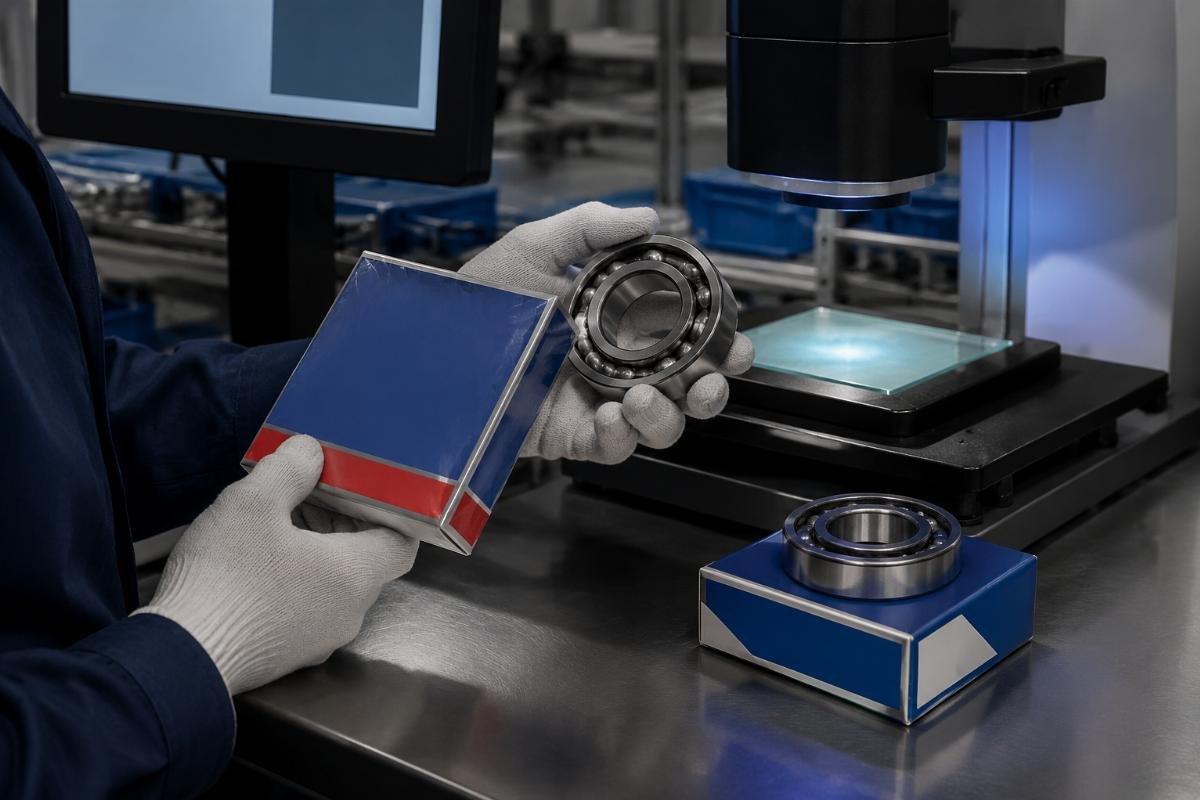
A distributor in Central Asia once received a bulk order of 6305 bearings from a new supplier. The price was significantly lower than market average. When I inspected the shipment, the QR codes on the packaging all returned the same verification result—a clear sign of cloned codes. The bearings were counterfeit. The distributor avoided a major loss by catching the issue before installation. [NEED_CITE: common counterfeit bearing detection methods and case studies]
For buyers, the message is clear: never rely on a single verification method. A SKF and NTN cross-reference wholesale supplier who offers multi-layer authenticity checks is protecting your equipment, your reputation, and your bottom line.
What Are the Real Costs of Counterfeit Bearings in Industrial Applications?
The true cost of a counterfeit bearing is never the purchase price—it’s the downtime, the collateral damage, and the lost production.
When a counterfeit bearing fails, the consequences cascade. The immediate failure may damage the shaft, the housing, the seals, or even the entire machine. The downtime required to diagnose the failure, source a replacement, and reinstall can stretch from hours to weeks, depending on the application and the availability of spare parts. In critical industries like mining, cement, or power generation, a single unplanned shutdown can cost a mid-six-figure sum or more. [NEED_CITE: industrial downtime cost analysis related to bearing failures]
I’ve seen this pattern repeatedly. A steel mill in the Middle East replaced a set of spherical roller bearings in a continuous caster with a batch of counterfeit product. The bearings failed within weeks, causing a roll seizure that damaged the roll neck and the housing. The repair took an extended period, and the lost production far exceeded the savings from buying the fake bearings. [NEED_CITE: case studies of counterfeit bearing failures in heavy industry]
Another example: a mining operation in Africa installed counterfeit tapered roller bearings in a conveyor drive. The bearings overheated and seized, causing the conveyor belt to tear. The belt replacement and the conveyor repair took weeks, and the lost production was measured in thousands of tons of ore. The counterfeit bearings had saved a small amount on the purchase price, but the total cost was many times higher.

The antidote is simple but non-negotiable: source from a SKF and NTN cross-reference wholesale supplier who guarantees authenticity, provides full traceability, and stands behind every shipment. The price difference between genuine and counterfeit is always smaller than the cost of a failure.
How Should Distributors and MRO Buyers Plan Their 2026 Bearing Inventory?
Inventory planning in 2026 requires balancing fast-moving standard models with application-specific variants, while locking in authorized sourcing channels and cross-reference flexibility.
The most frequently requested models—6205, 6206, 6305, 22320, 32218, 30206—are the backbone of any distributor’s stock. These deep groove ball bearings, spherical roller bearings, and tapered roller bearings cover a wide range of industrial and automotive applications. However, stocking the right variant is just as important as stocking the right model. Clearance class, cage material, and sealing type can vary significantly even within the same model number. [NEED_CITE: bearing inventory optimization strategies for distributors and MRO buyers]
For distributors in the Middle East, Africa, and Latin America, the demand pattern is consistent: heavy industry and mining drive the need for spherical roller bearings and tapered roller bearings, while general manufacturing and automotive repair drive the need for deep groove ball bearings. The key is to stock the variants that match the local application environment—high temperature, high load, dusty conditions, or high speed.
For MRO buyers, the challenge is different. You need to maintain a stock of replacement bearings that match the OEM specifications of your equipment. This requires not just the model number, but the full cross-reference data, including clearance, cage material, and origin. A SKF and NTN cross-reference wholesale supplier who can provide this data—and verify the authenticity of every unit—is an essential partner. [NEED_CITE: MRO bearing procurement best practices and cross-reference support]

A distributor in South America once asked me to help him optimize his inventory. He was stocking multiple variants of the same model, but many of them didn’t match the local application requirements. We reviewed his sales data, identified the most frequently requested variants, and consolidated his stock around those. The result was a leaner inventory, fewer stockouts, and higher customer satisfaction. The key was having a supplier who could provide not just the bearings, but the technical guidance to match the right variant to the right application.
Conclusion
Market position guides your brand choice, but cross-reference accuracy and authenticity verification determine your success. In 2026, SKF and NTN remain the leading brands in the global premium bearing market, but their strengths vary by region and application. Buyers who treat cross-referencing as a technical discipline, who verify authenticity through multiple layers, and who source from a trusted SKF and NTN cross-reference wholesale supplier will avoid the hidden costs of counterfeits and secure reliable equipment performance. The bearing is a small component, but its impact on your operation is enormous—choose wisely, verify thoroughly, and source with confidence.
Tags
Leave a Reply