
Installation & Maintenance

Vibration Analysis for SKF and NTN Bearings in Service: Wholesale Supplier Guide

9 min read
Vibration Analysis for SKF and NTN Bearings in Service: Wholesale Supplier Guide

Vibration Analysis for SKF and NTN Bearings in Service: Wholesale Supplier Guide

Most vibration anomalies engineers blame on installation errors actually trace back to counterfeit or mis-sourced bearings sitting inside the housing.

Vibration analysis for SKF and NTN bearings in service is a proven predictive maintenance method, but abnormal readings after replacement almost always point to authenticity gaps, internal clearance mismatches, or heat-treatment inconsistencies in non-genuine units—not pure mechanical failure. Verifying authenticity before installation and sourcing through authorized channels is the single most effective step to stabilize vibration baselines.

I still remember a crusher main-shaft failure at a cement plant in the Middle East. The SKF 22320 spherical roller bearing kept throwing high overall vibration. Envelope spectrum showed a clear inner-race defect frequency. We pulled the unit and found early-stage spalling on the raceway. The maintenance supervisor mentioned casually that the replacement came from a local open market. When I held the suspect bearing next to a reference sample, the font on the rubber seal was visibly off—half a character size smaller, strokes thinner. After we sourced a genuine NTN equivalent through an authorized channel and ran the cross-reference for internal clearance class, the overall vibration dropped noticeably on the first run-up. That job reshaped how I approach every vibration ticket: I ask where the bearing came from before I touch the analyzer. [NEED_CITE: root cause distribution of rolling bearing failures per ISO 15243]

Vibration analyzer screen showing envelope spectrum with inner-race defect frequency highlighted for a spherical roller bearing

Once authenticity is confirmed, the real diagnostic work begins, and the methods below are what separate guesswork from repeatable fault isolation.

Why Does Vibration Analysis Matter for SKF and NTN Bearings?

Vibration analysis is the backbone of condition-based maintenance for rotating equipment, and SKF and NTN bearings dominate the installed base across cement, steel, mining, and power generation. The technique captures acceleration, velocity, and displacement signatures that reveal developing faults long before thermal or audible symptoms appear. [NEED_CITE: vibration severity evaluation criteria per ISO 10816 for industrial machinery]

In practice, vibration analysis for SKF and NTN bearings in service follows a three-parameter logic. Overall velocity (mm/s RMS) gives a general health indication. Acceleration (g or m/s²) is sensitive to early-stage impacting from spalls or cracks. Displacement (µm peak-to-peak) highlights low-frequency issues like unbalance or misalignment. When velocity stays within ISO limits but acceleration trends upward, the bearing is usually in the earliest fault stage—exactly where intervention saves the most cost.

A European wind-farm operator once showed me a gearbox where overall velocity looked acceptable, but the high-frequency acceleration envelope had doubled over three months. The SKF 6305 deep-groove ball bearing supporting the intermediate shaft was developing a subtle outer-race defect that velocity alone would have missed for another half year. Catching it at that stage meant a planned swap during the next scheduled turbine service instead of an emergency crane mobilization.

Three-parameter vibration comparison chart showing acceleration, velocity, and displacement trends for an early-stage bearing fault

The key takeaway is that vibration analysis for SKF and NTN bearings in service is not about chasing a single threshold number. It is about reading the trend, the frequency content, and the phase relationship together.

How to Read Envelope Spectrum for Bearing Fault Diagnosis?

Envelope spectrum analysis separates bearing-specific defect frequencies from background machine noise, making it the most reliable frequency-domain tool for pinpointing which ring or rolling element is damaged. The technique demodulates high-frequency resonance bursts caused by impacts, then applies FFT to reveal the underlying defect repetition rate. [NEED_CITE: bearing defect frequency calculation formulas per ABMA and manufacturer technical handbooks]

The standard diagnostic workflow runs as follows:

  1. Mount an accelerometer on the bearing housing in the radial load zone, ensuring solid mechanical coupling.
  2. Acquire a time-waveform at a sampling rate high enough to capture the structural resonance band—typically several times the bearing’s natural frequency.
  3. Apply a band-pass filter around the resonance peak to isolate impact-related energy.
  4. Perform Hilbert transform to extract the signal envelope.
  5. Run FFT on the envelope to produce the envelope spectrum.
  6. Overlay the theoretical defect frequencies: BPFO (outer race), BPFI (inner race), BSF (ball or roller spin), and FTF (cage frequency).

A steel mill in South America brought in a fan unit that had been vibrating heavily after a bearing swap. The overall spectrum was a mess of structural noise. Once we ran the envelope, a sharp peak sat exactly on the calculated BPFI for the installed SKF 22320. We pulled the bearing and found a small spall on the inner race—consistent with a manufacturing defect or a handling damage that slipped through a non-genuine supply chain. [NEED_CITE: envelope analysis methodology for rolling element bearing diagnostics]

Envelope spectrum plot with BPFO, BPFI, and BSF defect frequency markers overlaid on a bearing vibration signal

When performing vibration analysis for SKF and NTN bearings in service, always calculate the theoretical defect frequencies from the exact bearing geometry before comparing them to measured peaks. Even small differences in ball count, contact angle, or pitch diameter between brands shift the frequencies enough to cause misdiagnosis.

What Causes Abnormal Vibration After Bearing Replacement?

The three dominant causes are counterfeit bearings, incorrect clearance or type selection, and improper installation—but counterfeit units are far more common than most maintenance teams admit.

Counterfeit bearings cause abnormal vibration because their internal geometry, surface finish, and heat-treatment quality deviate from the original specification. The raceway roughness is higher, the dimensional tolerances are looser, and the residual stress profile from heat treatment is inconsistent. All of these factors raise the vibration baseline and accelerate fatigue. [NEED_CITE: vibration quality grading for rolling bearings per ISO 15243 and manufacturer specifications]

A common misconception is that vibration analysis for SKF and NTN bearings in service will always show a textbook defect frequency when a counterfeit unit is installed. In reality, counterfeit bearings often produce broadband elevation without a sharp defect peak, because the noise comes from distributed surface irregularities rather than a discrete spall. This makes them harder to diagnose and easier to blame on "just a rough bearing."

Another frequent mistake is assuming that SKF and NTN bearings of the same nominal designation are fully interchangeable without checking internal clearance. A C3 clearance bearing swapped into a C0 application will run with excessive internal play, raising vibration at certain speeds. Conversely, a C0 unit in a hot-running application may preload and overheat. The part numbers look identical on the outside, but the internal geometry tells a different story.

Comparison of vibration spectrum from a genuine bearing versus a counterfeit bearing showing broadband noise elevation

When vibration analysis for SKF and NTN bearings in service shows unexpected broadband noise after a fresh installation, the first question should never be "did we install it wrong?" It should be "where did this bearing come from?"

How to Verify SKF and NTN Bearing Authenticity Before Installation?

Authenticity verification must happen before the bearing goes on the shaft, not after the vibration data looks wrong. The verification process combines visual inspection, packaging validation, and supply-chain traceability.

Start with the seal and marking inspection. Genuine SKF and NTN bearings carry laser-etched or stamped markings on the rings and rubber seals. The font, depth, and spacing follow strict manufacturer standards. Counterfeit units often show font size deviations, uneven character spacing, or markings that can be scratched off with moderate pressure. [NEED_CITE: anti-counterfeiting identification guidelines published by major bearing manufacturers]

Next, check the packaging. Original boxes include high-resolution printing, correct barcode format, and—on most recent production—QR codes or holographic labels that link to the manufacturer’s verification portal. Scan the code before opening the box. If the code is missing, duplicated across multiple boxes, or redirects to an unverified website, treat the unit as suspect.

Then verify the supply chain. Request the certificate of authorization from the seller. Cross-check the seller’s name against the official authorized distributor list published by SKF or NTN for the destination country. A legitimate supplier will provide this documentation without hesitation.

Finally, request a mill test certificate or certificate of origin for large orders. This document traces the bearing back to the manufacturing facility and confirms the production batch.

Close-up comparison of genuine versus counterfeit bearing seal markings showing font and laser depth differences

For teams performing vibration analysis for SKF and NTN bearings in service, building a pre-installation verification checklist is just as important as the analyzer itself. A five-minute check at the receiving dock prevents weeks of troubleshooting later.

Where to Source Genuine SKF and NTN Bearings with Cross-Reference Support?

Reliable sourcing of genuine SKF and NTN bearings requires working with suppliers who combine authorized-channel procurement, in-house authenticity verification, and cross-brand interchange expertise.

The industrial bearing market spans six major brands—SKF, NTN, NSK, FAG, TIMKEN, and KOYO—and maintenance teams frequently need to cross-reference between them when supply constraints hit. A spherical roller bearing designated 22320 from SKF may need to be matched to an NTN equivalent with identical external dimensions, internal clearance class, and cage design. Getting this wrong introduces vibration problems that no amount of spectral analysis can fix after the fact.

A distributor in West Africa once ordered a batch of tapered roller bearings for a mining conveyor. The OEM drawing called for a specific TIMKEN designation, but lead times stretched beyond the shutdown window. The local agent offered an unbranded substitute at a lower price. The conveyor ran for a few weeks, then the vibration climbed sharply. When we reviewed the installation, the substitute bearing had a different internal geometry and a cage design that did not match the original load distribution. We sourced the correct TIMKEN unit through an authorized channel, verified the cross-reference against the NTN and SKF equivalents for future planning, and the vibration baseline returned to specification. [NEED_CITE: cross-reference interchange methodology across major bearing brands per ABMA dimensional standards]
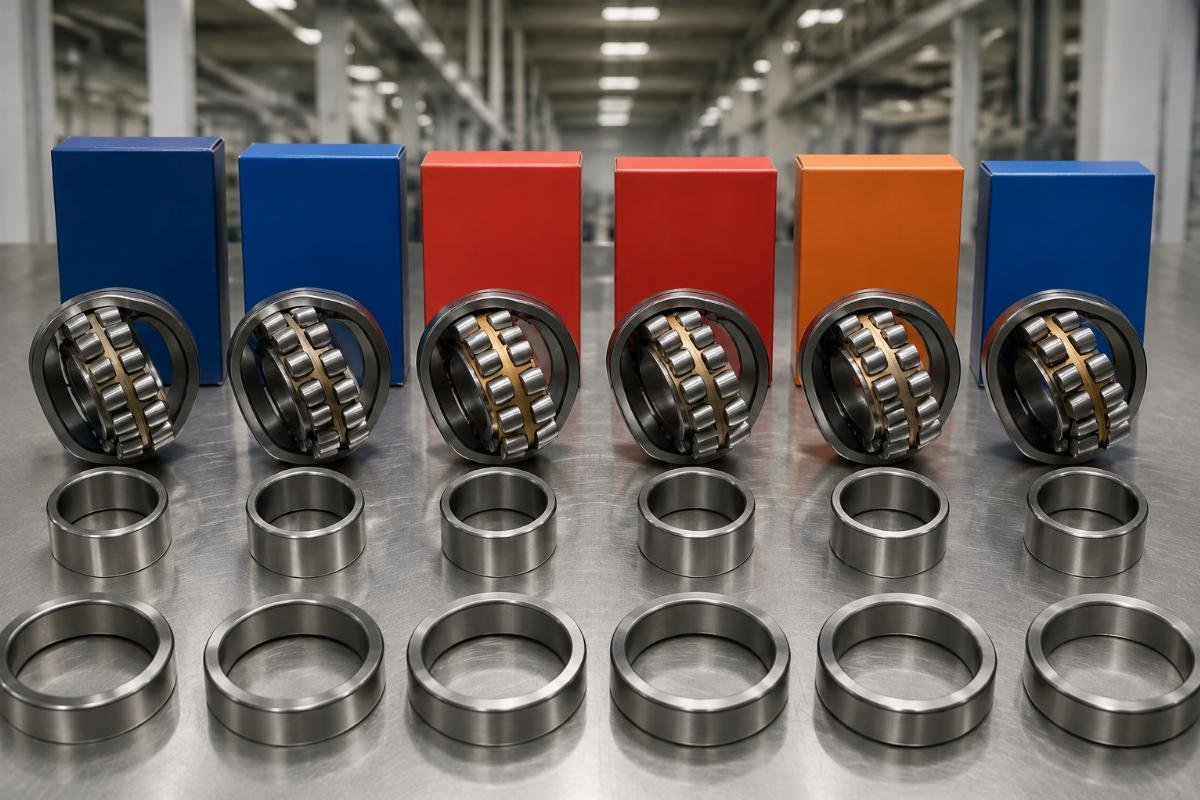
Cross-reference matrix showing dimensional and clearance equivalence across SKF, NTN, NSK, FAG, TIMKEN, and KOYO spherical roller bearings

When vibration analysis for SKF and NTN bearings in service is part of your maintenance program, your sourcing partner should be able to support three things simultaneously: authenticity guarantee, authorized-channel traceability, and technical cross-reference across brands. Without all three, the vibration data will keep telling you that something is wrong—and you will keep replacing bearings without solving the root cause.

Conclusion

Vibration analysis for SKF and NTN bearings in service is a powerful diagnostic method, but its value collapses when the bearings themselves are not genuine or correctly specified. Authenticity verification before installation, proper clearance selection during cross-referencing, and sourcing through authorized channels form the foundation that makes spectral analysis meaningful. When these three elements are in place, vibration data becomes a reliable predictor of remaining life. When they are missing, even the most advanced analyzer will only confirm that the wrong bearing is spinning inside the housing.

About the Author

author
author

Editor covering global sourcing, supplier verification, and industrial product knowledge. Content is compiled from manufacturer specifications, industry standards, and hands-on experience with international B2B buyers. Every article is fact-checked before publishing to help procurement professionals make informed decisions.

View all posts

Leave a Reply

Your email address will not be published. Required fields are marked *

Youchi Bearings

Ready to Source SKF & NTN Bearings?

1,100+ clients across 50+ countries trust our dual-brand supply chain. Get your tailored quote within 24 hours.

ISO 9001 SKF AUTH. NTN AUTH.

Vibration Analysis for SKF and NTN Bearings in Service: Wholesale Supplier Guide

author author 9 min read
Vibration analyzer screen showing envelope spectrum with inner-race defect frequency highlighted for a spherical roller bearing

Vibration Analysis for SKF and NTN Bearings in Service: Wholesale Supplier Guide

Most vibration anomalies engineers blame on installation errors actually trace back to counterfeit or mis-sourced bearings sitting inside the housing.

Vibration analysis for SKF and NTN bearings in service is a proven predictive maintenance method, but abnormal readings after replacement almost always point to authenticity gaps, internal clearance mismatches, or heat-treatment inconsistencies in non-genuine units—not pure mechanical failure. Verifying authenticity before installation and sourcing through authorized channels is the single most effective step to stabilize vibration baselines.

I still remember a crusher main-shaft failure at a cement plant in the Middle East. The SKF 22320 spherical roller bearing kept throwing high overall vibration. Envelope spectrum showed a clear inner-race defect frequency. We pulled the unit and found early-stage spalling on the raceway. The maintenance supervisor mentioned casually that the replacement came from a local open market. When I held the suspect bearing next to a reference sample, the font on the rubber seal was visibly off—half a character size smaller, strokes thinner. After we sourced a genuine NTN equivalent through an authorized channel and ran the cross-reference for internal clearance class, the overall vibration dropped noticeably on the first run-up. That job reshaped how I approach every vibration ticket: I ask where the bearing came from before I touch the analyzer. [NEED_CITE: root cause distribution of rolling bearing failures per ISO 15243]

Vibration analyzer screen showing envelope spectrum with inner-race defect frequency highlighted for a spherical roller bearing

Once authenticity is confirmed, the real diagnostic work begins, and the methods below are what separate guesswork from repeatable fault isolation.

Why Does Vibration Analysis Matter for SKF and NTN Bearings?

Vibration analysis is the backbone of condition-based maintenance for rotating equipment, and SKF and NTN bearings dominate the installed base across cement, steel, mining, and power generation. The technique captures acceleration, velocity, and displacement signatures that reveal developing faults long before thermal or audible symptoms appear. [NEED_CITE: vibration severity evaluation criteria per ISO 10816 for industrial machinery]

In practice, vibration analysis for SKF and NTN bearings in service follows a three-parameter logic. Overall velocity (mm/s RMS) gives a general health indication. Acceleration (g or m/s²) is sensitive to early-stage impacting from spalls or cracks. Displacement (µm peak-to-peak) highlights low-frequency issues like unbalance or misalignment. When velocity stays within ISO limits but acceleration trends upward, the bearing is usually in the earliest fault stage—exactly where intervention saves the most cost.

A European wind-farm operator once showed me a gearbox where overall velocity looked acceptable, but the high-frequency acceleration envelope had doubled over three months. The SKF 6305 deep-groove ball bearing supporting the intermediate shaft was developing a subtle outer-race defect that velocity alone would have missed for another half year. Catching it at that stage meant a planned swap during the next scheduled turbine service instead of an emergency crane mobilization.

Three-parameter vibration comparison chart showing acceleration, velocity, and displacement trends for an early-stage bearing fault

The key takeaway is that vibration analysis for SKF and NTN bearings in service is not about chasing a single threshold number. It is about reading the trend, the frequency content, and the phase relationship together.

How to Read Envelope Spectrum for Bearing Fault Diagnosis?

Envelope spectrum analysis separates bearing-specific defect frequencies from background machine noise, making it the most reliable frequency-domain tool for pinpointing which ring or rolling element is damaged. The technique demodulates high-frequency resonance bursts caused by impacts, then applies FFT to reveal the underlying defect repetition rate. [NEED_CITE: bearing defect frequency calculation formulas per ABMA and manufacturer technical handbooks]

The standard diagnostic workflow runs as follows:

  1. Mount an accelerometer on the bearing housing in the radial load zone, ensuring solid mechanical coupling.
  2. Acquire a time-waveform at a sampling rate high enough to capture the structural resonance band—typically several times the bearing’s natural frequency.
  3. Apply a band-pass filter around the resonance peak to isolate impact-related energy.
  4. Perform Hilbert transform to extract the signal envelope.
  5. Run FFT on the envelope to produce the envelope spectrum.
  6. Overlay the theoretical defect frequencies: BPFO (outer race), BPFI (inner race), BSF (ball or roller spin), and FTF (cage frequency).

A steel mill in South America brought in a fan unit that had been vibrating heavily after a bearing swap. The overall spectrum was a mess of structural noise. Once we ran the envelope, a sharp peak sat exactly on the calculated BPFI for the installed SKF 22320. We pulled the bearing and found a small spall on the inner race—consistent with a manufacturing defect or a handling damage that slipped through a non-genuine supply chain. [NEED_CITE: envelope analysis methodology for rolling element bearing diagnostics]

Envelope spectrum plot with BPFO, BPFI, and BSF defect frequency markers overlaid on a bearing vibration signal

When performing vibration analysis for SKF and NTN bearings in service, always calculate the theoretical defect frequencies from the exact bearing geometry before comparing them to measured peaks. Even small differences in ball count, contact angle, or pitch diameter between brands shift the frequencies enough to cause misdiagnosis.

What Causes Abnormal Vibration After Bearing Replacement?

The three dominant causes are counterfeit bearings, incorrect clearance or type selection, and improper installation—but counterfeit units are far more common than most maintenance teams admit.

Counterfeit bearings cause abnormal vibration because their internal geometry, surface finish, and heat-treatment quality deviate from the original specification. The raceway roughness is higher, the dimensional tolerances are looser, and the residual stress profile from heat treatment is inconsistent. All of these factors raise the vibration baseline and accelerate fatigue. [NEED_CITE: vibration quality grading for rolling bearings per ISO 15243 and manufacturer specifications]

A common misconception is that vibration analysis for SKF and NTN bearings in service will always show a textbook defect frequency when a counterfeit unit is installed. In reality, counterfeit bearings often produce broadband elevation without a sharp defect peak, because the noise comes from distributed surface irregularities rather than a discrete spall. This makes them harder to diagnose and easier to blame on "just a rough bearing."

Another frequent mistake is assuming that SKF and NTN bearings of the same nominal designation are fully interchangeable without checking internal clearance. A C3 clearance bearing swapped into a C0 application will run with excessive internal play, raising vibration at certain speeds. Conversely, a C0 unit in a hot-running application may preload and overheat. The part numbers look identical on the outside, but the internal geometry tells a different story.

Comparison of vibration spectrum from a genuine bearing versus a counterfeit bearing showing broadband noise elevation

When vibration analysis for SKF and NTN bearings in service shows unexpected broadband noise after a fresh installation, the first question should never be "did we install it wrong?" It should be "where did this bearing come from?"

How to Verify SKF and NTN Bearing Authenticity Before Installation?

Authenticity verification must happen before the bearing goes on the shaft, not after the vibration data looks wrong. The verification process combines visual inspection, packaging validation, and supply-chain traceability.

Start with the seal and marking inspection. Genuine SKF and NTN bearings carry laser-etched or stamped markings on the rings and rubber seals. The font, depth, and spacing follow strict manufacturer standards. Counterfeit units often show font size deviations, uneven character spacing, or markings that can be scratched off with moderate pressure. [NEED_CITE: anti-counterfeiting identification guidelines published by major bearing manufacturers]

Next, check the packaging. Original boxes include high-resolution printing, correct barcode format, and—on most recent production—QR codes or holographic labels that link to the manufacturer’s verification portal. Scan the code before opening the box. If the code is missing, duplicated across multiple boxes, or redirects to an unverified website, treat the unit as suspect.

Then verify the supply chain. Request the certificate of authorization from the seller. Cross-check the seller’s name against the official authorized distributor list published by SKF or NTN for the destination country. A legitimate supplier will provide this documentation without hesitation.

Finally, request a mill test certificate or certificate of origin for large orders. This document traces the bearing back to the manufacturing facility and confirms the production batch.

Close-up comparison of genuine versus counterfeit bearing seal markings showing font and laser depth differences

For teams performing vibration analysis for SKF and NTN bearings in service, building a pre-installation verification checklist is just as important as the analyzer itself. A five-minute check at the receiving dock prevents weeks of troubleshooting later.

Where to Source Genuine SKF and NTN Bearings with Cross-Reference Support?

Reliable sourcing of genuine SKF and NTN bearings requires working with suppliers who combine authorized-channel procurement, in-house authenticity verification, and cross-brand interchange expertise.

The industrial bearing market spans six major brands—SKF, NTN, NSK, FAG, TIMKEN, and KOYO—and maintenance teams frequently need to cross-reference between them when supply constraints hit. A spherical roller bearing designated 22320 from SKF may need to be matched to an NTN equivalent with identical external dimensions, internal clearance class, and cage design. Getting this wrong introduces vibration problems that no amount of spectral analysis can fix after the fact.

A distributor in West Africa once ordered a batch of tapered roller bearings for a mining conveyor. The OEM drawing called for a specific TIMKEN designation, but lead times stretched beyond the shutdown window. The local agent offered an unbranded substitute at a lower price. The conveyor ran for a few weeks, then the vibration climbed sharply. When we reviewed the installation, the substitute bearing had a different internal geometry and a cage design that did not match the original load distribution. We sourced the correct TIMKEN unit through an authorized channel, verified the cross-reference against the NTN and SKF equivalents for future planning, and the vibration baseline returned to specification. [NEED_CITE: cross-reference interchange methodology across major bearing brands per ABMA dimensional standards]

Cross-reference matrix showing dimensional and clearance equivalence across SKF, NTN, NSK, FAG, TIMKEN, and KOYO spherical roller bearings

When vibration analysis for SKF and NTN bearings in service is part of your maintenance program, your sourcing partner should be able to support three things simultaneously: authenticity guarantee, authorized-channel traceability, and technical cross-reference across brands. Without all three, the vibration data will keep telling you that something is wrong—and you will keep replacing bearings without solving the root cause.

Conclusion

Vibration analysis for SKF and NTN bearings in service is a powerful diagnostic method, but its value collapses when the bearings themselves are not genuine or correctly specified. Authenticity verification before installation, proper clearance selection during cross-referencing, and sourcing through authorized channels form the foundation that makes spectral analysis meaningful. When these three elements are in place, vibration data becomes a reliable predictor of remaining life. When they are missing, even the most advanced analyzer will only confirm that the wrong bearing is spinning inside the housing.

Leave a Reply

Your email address will not be published. Required fields are marked *

Keep Reading